
Pizza Troubleshooting Guide: Fix Every Common Fault

Most home pizza faults trace back to one of three variables: the dough, the stone temperature, or the launch. When I diagnose a bad bake, I check those in that order — and roughly eight times out of ten the fix costs nothing, because it is a timing or temperature decision, not a gear problem. This guide is the map I work from.
I have spent years running the same dough across different oven classes — gas, dual-fuel dome, indoor electric, and a humble steel in the kitchen oven — specifically so I can separate what is the oven’s fault from what is mine. That is the lens here. Every fault below is sorted into “this is the dough talking” or “this is the heat talking,” because once you know which one you are looking at, the fix is usually obvious.
How I Diagnose Any Pizza Fault
Diagnosis is a sequence, not a guess. I check the stone temperature with the IR gun, then I look at the underside of the crust, then I think back through the dough’s ferment. Those three readings — stone temp, base color, ferment history — isolate almost every common fault in under a minute.
The underside of the pizza is the single most honest piece of evidence you have. A pale, floppy base means the stone was too cold or the bake too short. A black, acrid base with a raw rim means the floor was screaming hot while the air was not. Even browning with a set rim means the heat was balanced and the problem, if any, is upstream in the dough. Before I change anything, I read the base — it tells me whether to reach for the thermometer or the dough log.
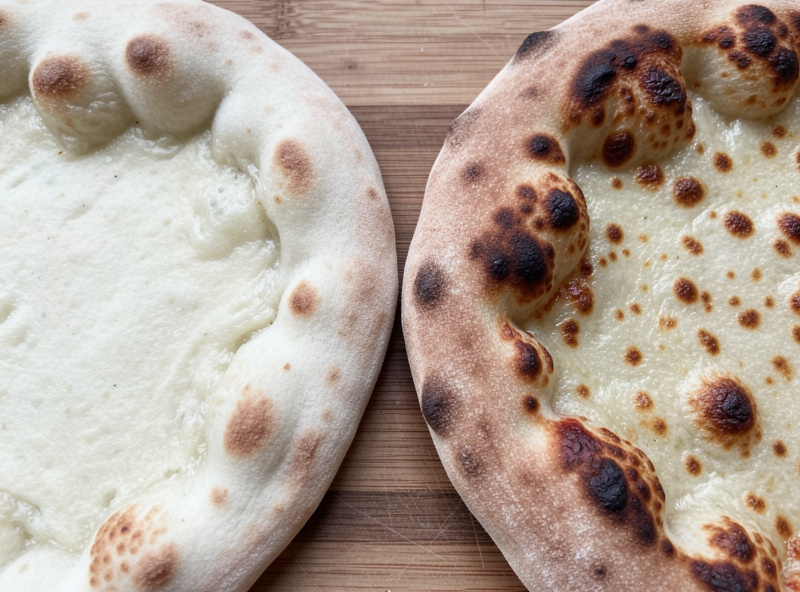
The second habit is logging. In my dough log I write hydration, flour, ferment time and temperature, stone temp at launch, and the result for every bake worth remembering. It sounds fussy. It is the difference between “my pizza was bad again” and “my 65% dough at a 400°C stone with a 48-hour cold ferment leoparded perfectly” — a sentence you can actually repeat.
There is one more reading I take that most people skip: the smell and feel of the dough before it ever goes near heat. A dough that smells faintly sweet and yeasty, springs back slowly when poked, and shows a scatter of bubbles is ready. A dough that smells sharp and boozy and stays dented when poked has overfermented and will bake dense and slack. A dough that smells of almost nothing and springs back instantly is underfermented and will bake tight and pale. I make that call at the bench, before I commit a single pizza to the stone, because it tells me whether tonight’s faults will be dough faults or heat faults — and that changes everything about how I run the oven.
The Big Five Faults at a Glance
Here is the fast lookup. Match your symptom to the row, note whether it is a dough problem or a heat problem, and jump to the dedicated guide for the full fix. Every one of these has a focused walkthrough linked in the table.
| Symptom | Root cause class | The one-line fix | Full guide |
|---|---|---|---|
| Soggy, wet center under the toppings | Moisture / load | Drier sauce, lighter load, hotter floor | Fixing a soggy center |
| Burnt bottom but raw, pale top | Heat balance | Lower the floor, raise the air, soak the stone less | Burnt bottom, raw top |
| Dough tears or holes when you shape it | Dough / gluten | Longer rest, gentler hands, check hydration | Dough tearing when shaping |
| Dense, bready crust with no rise | Dough / ferment | More active leaven, longer ferment, hotter bake | Dense crust fix |
| Wet, undercooked band under the sauce | The gum line | Thinner sauce layer, more floor heat, drier base | The gum line explained |
Soggy or Wet Center
A soggy center is almost always a moisture-and-load problem, not an oven problem. The middle of the pizza is the last place to set and the first place to collect water from a wet sauce, a heavy cheese pile, or vegetables that weep as they heat. The cure is to give the floor less water to fight and more heat to fight it with.
My standing rule is that the center carries the lightest load on the whole pie. I keep sauce to a thin, even skim — you should still see dough tinting through it — and I push the heavier toppings toward the rim where the base sets faster. If I am using fresh mozzarella, I tear it, drain it on paper for twenty minutes, and accept that wetter cheese means a hotter floor or it will steam the middle. The full breakdown, including the role of stone recovery time between bakes, is in the soggy center fix guide. It is closely related to the gum line, which is the specific undercooked band the moisture leaves behind.
Burnt Bottom, Raw Top
Burnt bottom with a raw top is a pure heat-balance fault: your floor is far hotter than your air. This is the signature failure of a portable gas oven that has been heat-soaking with the flame roaring — the stone climbs past 450°C while the dome air never catches up, so the base chars in forty seconds while the cheese sits pale and unset.
On my Ooni Koda 16 the fix is mechanical: I bring the flame down before launch so the stone stops gaining, let the dome air heat-soak, and check the floor with the IR gun until it reads where I want it for the style. A biscotto stone, which I run in the indoor electric, is far more forgiving here because it surrenders heat more gently and resists scorching. The complete launch-and-flame routine — including the turn cadence that keeps one edge from blackening — lives in the burnt bottom, raw top guide. If your problem is the opposite, a base that never colors at all, the raw center diagnosis covers the cold-floor case.
Dough That Tears When You Shape It
Tearing is the gluten telling you it is not ready, or that you are being too rough, or that the hydration and flour are mismatched. A well-rested, properly fermented ball should stretch like it wants to — it relaxes under its own weight and opens with the backs of your hands, no rolling pin, no fighting.
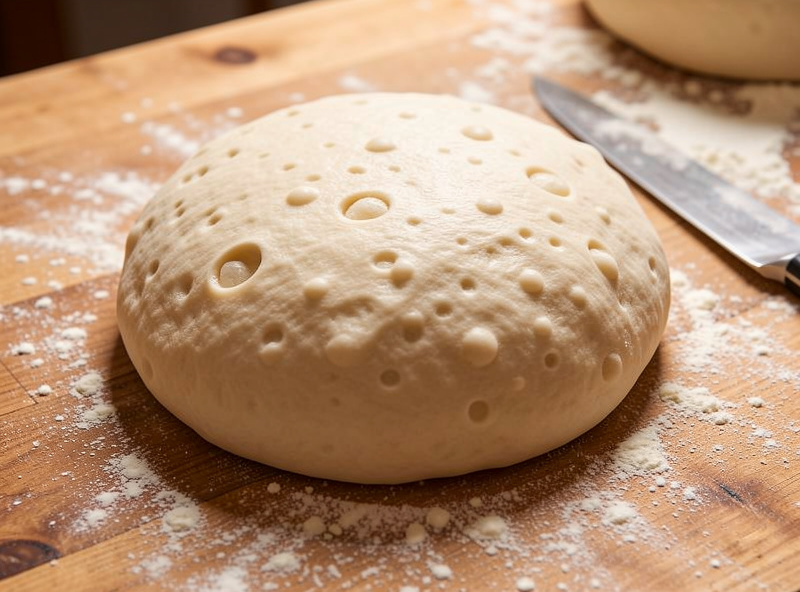
The three usual culprits: the dough is cold and tight straight from the fridge, the gluten under-developed for the hydration, or the flour too weak for the water you added. My default is a strong bread flour or a true 00 with enough W-strength to hold 65% hydration through a long cold ferment, then a two-hour bench rest so the balls come to room temperature and slacken before I open them. King Arthur Baking publishes the protein percentages that decide this — the flour’s strength, not the recipe, is what sets the hydration ceiling before the dough turns brittle. Cold dough tears; rested dough flows. The full shaping protocol and the hydration-to-flour matching table are in the dough tearing guide, and if your dough is sticking rather than tearing, the sticky dough fix is the companion piece.
Dense, Bready Crust With No Oven Spring
A dense crust that bakes up tight and bready, with no airy rim and no oven spring, is a fermentation failure nine times out of ten. The dough did not trap enough gas, or it lost the gas it had, so there is nothing to inflate when the heat hits. The oven gets blamed; the leaven is usually guilty.
Oven spring is the violent puff a pizza makes in the first thirty seconds — gas expanding, water flashing to steam, the structure setting around the bubbles. For that to happen the dough has to arrive at the stone full of life: an active starter or correctly dosed yeast, a ferment long enough to build structure but not so long it collapses, and a stone hot enough to flash the rim before it can deflate. Underproofed dough is the most common version of this fault, and it is the most fixable. The diagnosis — how to tell underproof from overproof from a flat-out dead culture — is in the dense crust fix guide.
The Gum Line — The Fault Hiding Under Your Sauce
The gum line is the dense, wet, undercooked layer of dough that sits directly under the sauce while the rest of the crust looks done. You only find it when you bite in or cut through. It is not a separate disease so much as the specific scar that moisture and an underheated floor leave in the one spot that has to cook through the most insulation.
It forms because the sauce layer is a wet blanket: water has to boil off before the dough beneath it can cross from gummy to set, and if the floor heat runs out before that happens, the band stays raw. The fixes stack — thinner sauce, a drier base, a hotter and better-recovered stone, and not crushing the center with toppings. Because so many people mistake the gum line for a soggy center or a raw center, I wrote a dedicated explainer: the gum line, explained.
Stone Temperature Discipline — The Root Cause Behind Half of These
If I could give a new oven owner one habit, it would be checking the stone with an IR thermometer before every launch. Stone temperature is the launch-decision number, and getting it wrong is the single biggest source of the faults above — soggy centers, burnt bottoms, gum lines, and pale bases all trace back to a floor that was the wrong temperature or had not recovered.
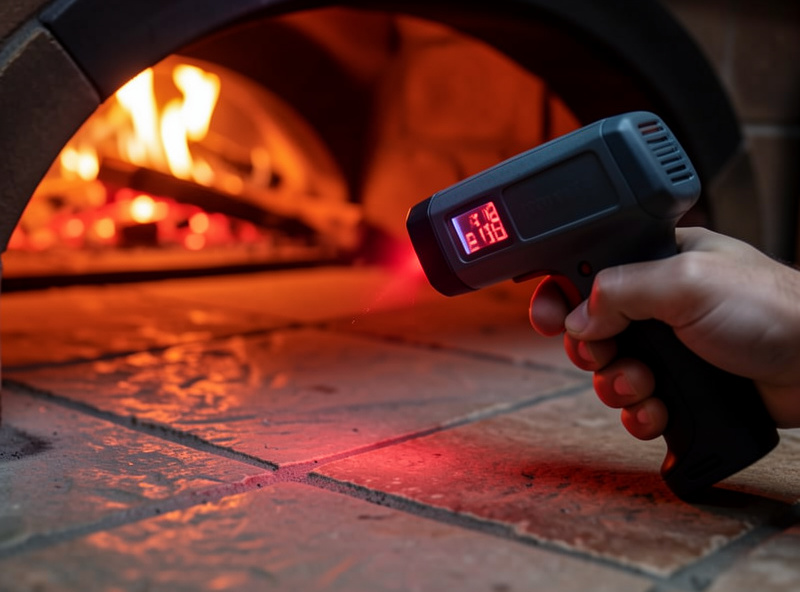
Heat soak is the other half people rush. A stone can read hot on the surface long before its core is saturated with heat, and a stone that is only hot on top steals heat from the base far too quickly, then quits — the classic pale, gummy center on what felt like a hot oven. I give the stone real time to saturate, not just to flash its surface, and on the indoor electric with its biscotto stone that patience is rewarded with a floor that holds steady bake after bake. Rushing the soak to save ten minutes costs you the whole bake night.
Recovery time is the part people miss. The stone dumps a huge amount of heat into the first pizza, and it needs time to climb back before the next one — launch onto a depleted floor and you get a pale, soggy base even though the oven “feels” hot. Different styles want different floors: a fast Neapolitan bake wants a very hot stone and a very hot dome in balance, while a steel in a home oven works at a lower floor over a longer bake. A good infrared thermometer gun turns all of this from guesswork into a number you can repeat.
As an Amazon Associate I earn from qualifying purchases.
When It Is the Dough Versus When It Is the Oven
The whole point of running the same dough across four oven classes is to learn to tell these apart fast. The shortcut: faults that show up no matter which oven you use are dough faults; faults that change when you change the oven are heat faults. Tearing, density, and a weak rim follow the dough wherever it goes. Burnt bottoms, pale tops, and slow bakes follow the oven.
The honest version of this is that most first upgrades should not be a new oven at all — they should be a colder, longer ferment and better flour. I have watched a 6mm steel in a kitchen oven, run with a proper 48-hour cold ferment, outbake a brand-new gas oven loaded with a rushed same-day dough. The oven is the last ninety seconds of a two-day process. If the dough is wrong, no stone temperature saves it. If the dough is right, even a modest setup makes a genuinely good pizza. For the Neapolitan-specific version of all this, the Neapolitan troubleshooting roundup drills into the 90-second bake — the window the AVPN disciplina actually codifies, oven floor and dome balanced for a 60-90 second bake.
A Five-Minute Pre-Bake Checklist
Most of my bad bakes were lost before the pizza ever touched the stone. A short pre-bake routine catches the faults above while they are still preventable, and it adds maybe five minutes to a bake night. I run the same checklist whether I am on the gas oven in the garden or the electric on the counter.
First, the dough: are the balls at room temperature, relaxed, and showing some bubble on the surface? A ball straight from the fridge is tight and will tear; a ball that has collapsed flat and smells sharply of alcohol has gone too far. Second, the stone: I heat-soak fully and take an IR reading, because “the oven has been on twenty minutes” is not the same as “the floor is at temperature.” Third, the bench: flour down, peel ready, toppings prepped and drained, sauce thinned, so the dressed pizza spends as little time as possible sitting on the peel soaking through. A skin that sits dressed for three minutes is a stuck launch waiting to happen. Do those three checks and you have eliminated the cold-floor soggy base, the tearing skin, and the stuck launch in one pass.
The last item is mental: decide your turn cadence before you launch. On a fast bake you do not have time to improvise. I know before the pizza goes in that I am turning at roughly the thirty-second mark and again every twenty seconds after, and that decision alone prevents the one-sided burns that make people think their oven is broken when it is just their timing. The first season I owned the Koda 16 I lost a dozen pizzas to exactly that — a black crescent on the flame side because I was still reaching for the turning peel when I should already have turned. Deciding the cadence in advance, out loud, fixed more of my early faults than any change to the dough ever did.
Cold-Climate Faults Nobody Warns You About
Baking outdoors in a Swedish winter taught me faults that no summer reviewer ever meets. When the ambient air is below freezing and the wind is moving, an oven’s published maximum temperature becomes almost meaningless — what matters is heat retention and recovery, and the cold exposes both mercilessly. The same gas oven that bakes a flawless pizza in July will pale-bake the second pie in January because the floor cannot recover against the cold load.
Two faults dominate. The first is the second-pizza slump: the stone gives up its heat to the first launch and, fighting cold air, never climbs back in time, so pizza two comes out soggy-centered and pale even though pizza one was perfect. The fix is longer recovery time between bakes and accepting a lower throughput, not a hotter starting temperature. The second is propane behaving badly in the cold — a tank in deep cold delivers a weaker, less consistent flame, which starves the dome air and tips you straight into the burnt-bottom-raw-top fault. This is exactly why my indoor electric earns its keep as the all-year reference: it does not care that it is minus five outside, and every outdoor bake gets judged against the consistency it delivers. If you bake in real cold, plan around retention and recovery, not the number on the spec sheet. In my dough log the January bakes are a separate column entirely: I pre-soak the stone ten to fifteen minutes longer than I would in summer, I bring the dough balls all the way to room temperature indoors before carrying them out, and I plan on three pizzas an hour rather than six, because every extra pie fights a colder floor than the last. The ovens that survive that test are the ones with real thermal mass — a thin, light floor that reads hot on the surface is exactly the floor that collapses fastest against a Nordic wind.
Frequently Asked Questions
Why is the middle of my pizza always undercooked?
The center is the last part to set and the first to collect moisture. A thin sauce layer, a lighter topping load in the middle, and a fully heat-soaked stone fix it. Most undercooked centers are a moisture-plus-floor-temperature problem, not a baking-time problem.
Is a soggy center the same as a gum line?
They overlap but are not identical. A soggy center is a general wet, undercooked middle. A gum line is the specific dense band of raw dough directly under the sauce. Both come from too much moisture meeting too little floor heat, and both fixes are similar.
Why does my pizza base burn before the top cooks?
Your floor is much hotter than your air. This is common on portable gas ovens after a hard heat-soak. Lower the flame before launch so the stone stops gaining, let the dome air catch up, and check the stone with an IR thermometer before you launch.
Do I need an expensive oven to fix these problems?
Usually not. A 6mm steel in a home oven with a 48-hour cold ferment outbakes a new gas oven run on rushed dough. Most first upgrades should be better flour and a longer cold ferment, not a new oven. The dough is the controlled variable that matters most.
How hot should my pizza stone be?
It depends on the style. A fast Neapolitan bake wants a very hot stone and balanced dome air, while a steel in a home oven works at a lower floor over a longer bake. Check it with an infrared thermometer before every launch and log what worked.
Why does my dough tear when I stretch it?
The dough is either too cold, under-fermented, or made with flour too weak for the hydration. Rest the balls two hours to room temperature before shaping, open them gently with your hands instead of a rolling pin, and match a strong flour to higher-hydration dough.
Related Guides
- Fixing a Soggy Pizza Center
- Burnt Bottom, Raw Top: The Heat-Balance Fix
- Why Your Pizza Dough Tears When You Shape It
- Fixing a Dense Pizza Crust
- The Gum Line in Pizza, Explained
- Neapolitan Pizza Troubleshooting

About Kenny Nyhus Fadil
A home pizza maker documenting deck temps, dough logs, and the occasional wrecked launch.