IR Thermometer Guide for Pizza Ovens: Read the Stone

An infrared thermometer is the most useful tool you can add to any pizza oven, because it reads the stone deck directly — the one temperature that decides whether your base cooks before your top burns. A model that reads to at least 500°C (930°F) with a tight 12:1 distance-to-spot ratio covers every home pizza style. It is the launch-decision number, full stop.
I have owned a drawer of these guns across years of bakes, and I check the stone with the IR gun before every single launch on every oven I run. Not the air, not the dial, not the glow — the spot where the pizza will actually land. This guide is how to choose one, how to use it so the reading means something, and the handful of mistakes that make the number lie to you. It sits under my pizza oven temperature guide, which is the bigger picture this tool serves.
Why an IR Gun and Not an Oven Probe
An air probe tells you the chamber is hot; an infrared thermometer tells you the surface that cooks your pizza is hot. Those are different numbers, and the gap between them is often 50–80°C right after a launch. The base bakes by conduction off the stone, so the deck reading is the only one that predicts your result — which is exactly why the gun, not the probe, lives in my apron pocket.
Infrared thermometers work by reading the heat a surface radiates, so they give you an instant, non-contact surface temperature at the exact spot you aim. A probe stuck in the air, or even one buried in the stone, cannot tell you what the launch zone is doing in the half-second before dough hits it. For a moving target like a deck that recovers and craters between pizzas, instant surface reads are the whole point. If you want the full why-the-stone-matters argument, it is in the hub; here I am assuming you already accept that the deck is king and want to measure it properly.
What to Look For When You Buy One
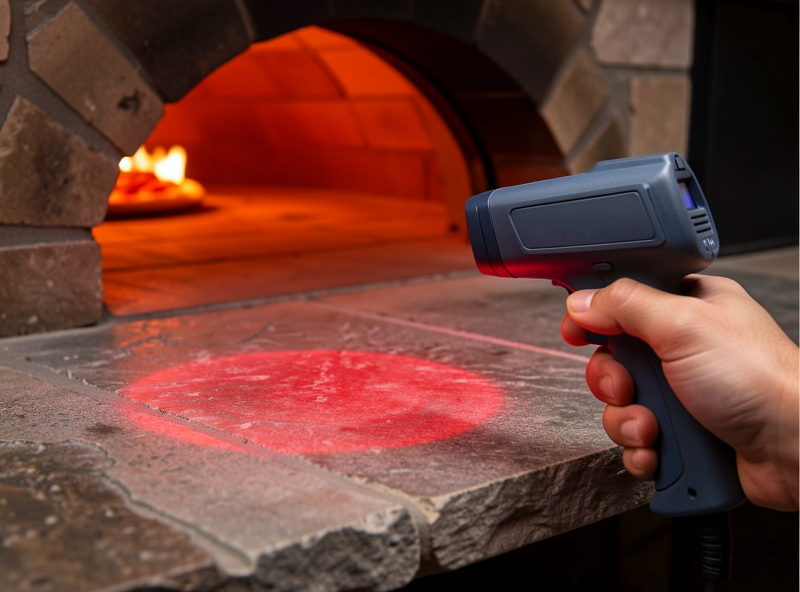
Three specs actually matter for pizza: temperature range, distance-to-spot ratio, and emissivity. You want a range that reaches at least 500°C so a Neapolitan deck does not peg the display, a distance-to-spot ratio of 12:1 or tighter so you are reading a small target spot and not averaging the cold floor around it, and ideally adjustable emissivity so you can dial it to roughly 0.95 for a stone surface. Everything else — backlight, colour, laser pointer shape — is comfort, not accuracy.
Cheap kitchen guns that top out at 380°C are the most common wasted purchase here; they simply cannot read a pizza deck at temperature and will show a meaningless max-out reading. I learned that the expensive way — my first gun was a 380°C kitchen unit that pegged solid the first time I aimed it at a heat-soaked Ooni Koda 16 deck, and I baked half a night blind before I admitted the tool, not the oven, was the problem. Spend on range and spot ratio, skip the rest. A solid general-purpose high-temperature infrared thermometer in the right range is inexpensive relative to the oven it serves, and it is the single highest-return accessory in the whole hobby. You can find suitable models with a search for an infrared thermometer for pizza ovens. As an Amazon Associate I earn from qualifying purchases.
| Method | Reads | Accuracy for Launch | Speed | Verdict |
|---|---|---|---|---|
| Infrared gun | Stone surface, exact spot | High | Instant | The launch-decision tool |
| Built-in oven gauge | Air, one location | Low for the deck | Continuous | Rough soak indicator only |
| Wired/probe thermometer | Air or buried point | Medium | Continuous | Good for soak, poor for launch |
| Flour-burn eyeball test | Rough surface heat | Very low | Slow | Backup when you forget the gun |
How to Take a Reading That Actually Means Something
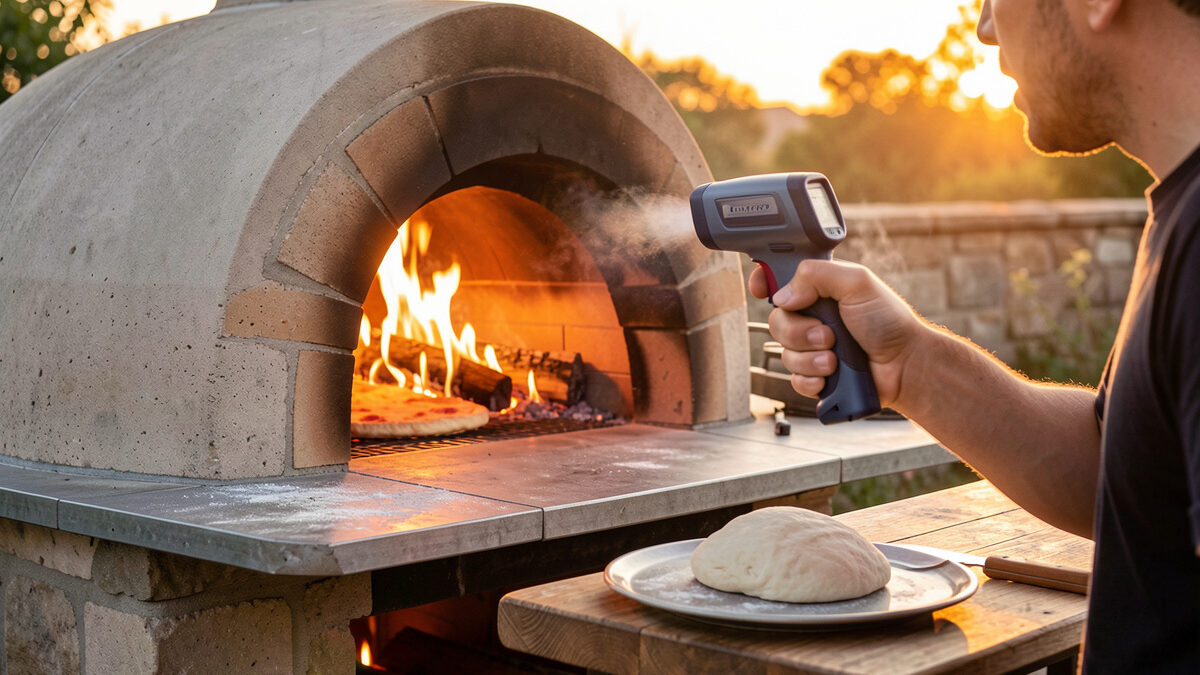
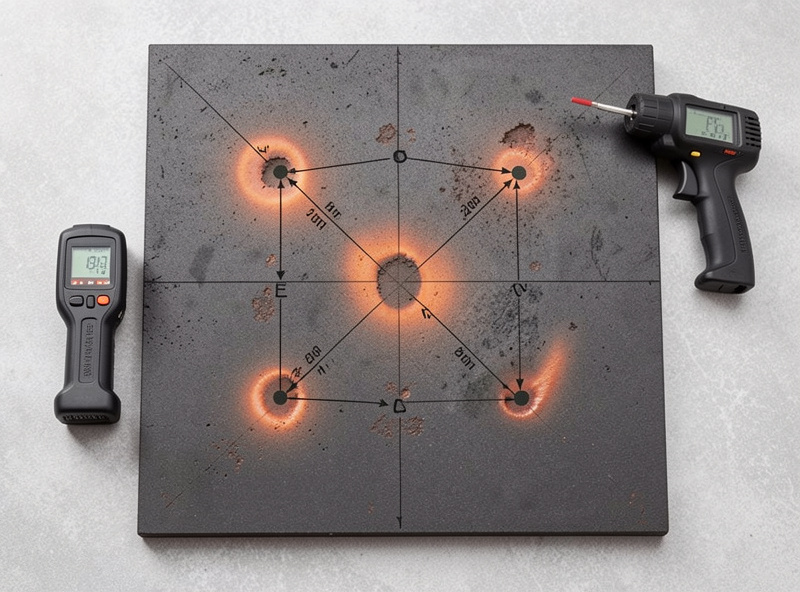
Aim at the exact spot the pizza will land, hold the gun 15–30 cm from the surface, and take three reads across the launch zone rather than trusting one. Decks are never uniform — the back and the area under the flame run hotter, the mouth and front run cooler — so a single centre reading can be 40–60°C off from where your pizza actually sits. Measure where it matters.
My routine is simple and I run it the same way every time: read the front-centre landing zone, read a hand-width back, read the side that takes the flame, and launch off the coolest of the three because that is the spot most likely to leave a pale base. Distance matters because of the spot ratio — get too far away and a 12:1 gun is averaging a dinner-plate-sized circle that includes cold oven floor. Get close, read the real landing zone, and the number finally tells the truth.
The Emissivity Trap and Other Ways the Number Lies
The most common reason an IR reading is wrong is a shiny surface. Infrared thermometers assume a matte, high-emissivity target; aim one at bare polished metal, a steel baking surface, or a glossy glazed tile and it reads far too low because the surface reflects rather than radiates. A matte cordierite or biscotto stone reads true at around 0.95 emissivity; a bright steel can fool a fixed-emissivity gun badly.
For a shiny steel I either use a gun with adjustable emissivity set appropriately or, more practically, I read a dusting of flour on the surface, which gives a matte target close to the real temperature. The other lies are simpler: reading through a heat shimmer at a steep angle, reading a spot the flame is directly licking (which over-reads), and reading immediately after opening a cold lid (which under-reads for a few seconds). Know these and the gun becomes trustworthy. This matters even more on a steel versus stone surface, where the material changes how the reading behaves.
Using the Gun to Manage a Whole Pizza Night
The IR gun is not just a pre-flight check — it is how you run recovery between pizzas. After each launch the deck craters, and the gun tells you the exact moment it has climbed back to your target so you can launch the next one without guessing. Launch on a timer and you bake on a cold deck; launch on the gun and every pizza lands on the same temperature as the first.
This is where the tool pays for itself ten times over. I stretch the next dough ball only when the gun confirms the deck has recovered to target, never on a clock, and that one discipline is what keeps pizza number five as good as pizza number one. On my Ooni Koda 16 the flame wall runs hot, so I read the cooler right-front landing zone; on my Effeuno electric with its biscotto stone the deck recovers slower but far more evenly, and the gun is what tells me which oven still needs another minute. The full recovery strategy is in my heat recovery between pizzas guide, and the related concept of letting the stone fully saturate before you start is covered in heat soak explained. For the actual target numbers to aim the gun at, see stone temperature by style.
Frequently Asked Questions
What temperature range do I need in an IR thermometer for pizza?
Buy one that reads to at least 500C (930F) so a Neapolitan deck does not peg the display. Cheap kitchen guns that top out around 380C cannot read a pizza deck at temperature and will show a meaningless max-out reading. Range is the spec that matters most.
Why does my infrared thermometer read low on a pizza steel?
Shiny metal reflects infrared instead of radiating it, so a fixed-emissivity gun reads a steel surface far too low. Use a gun with adjustable emissivity set near 0.85 for steel, or read a light dusting of flour on the surface to get a matte target close to the true temperature.
Where on the stone should I take the reading?
Aim at the exact spot the pizza will land, not the centre or the back. Decks are uneven, with the back and flame side running 40 to 60C hotter than the mouth. Take three reads across the launch zone and launch off the coolest, since that is where a pale base is most likely.
How far away should I hold the IR gun?
Hold it 15 to 30 cm from the surface. Infrared guns have a distance-to-spot ratio, so too far away means you are averaging a large circle that includes cold oven floor. Get close to read only the real landing zone, and the number becomes accurate.
Can I just use the oven built-in gauge instead?
No. The built-in gauge reads air temperature in one location, not the stone deck that cooks your base. It is fine as a rough heat-soak indicator while the oven comes up, but it cannot tell you the launch-decision number, which is the surface temperature where the pizza lands.
Keep Reading
- Pizza Oven Temperature Discipline: The Complete Guide
- Stone Temperature by Pizza Style
- Heat Recovery Between Pizzas
- Heat Soak Explained for Pizza Ovens
- Pizza Steel vs Stone: The Home-Oven Verdict

About Kenny Nyhus Fadil
A home pizza maker documenting deck temps, dough logs, and the occasional wrecked launch.
Keep Baking
Pizza Oven Heat Soak Explained: The Hidden Wait
Pizza Oven Cold Weather and Wind: Baking in Winter