IR Thermometer for Pizza Ovens: Is It Worth It?

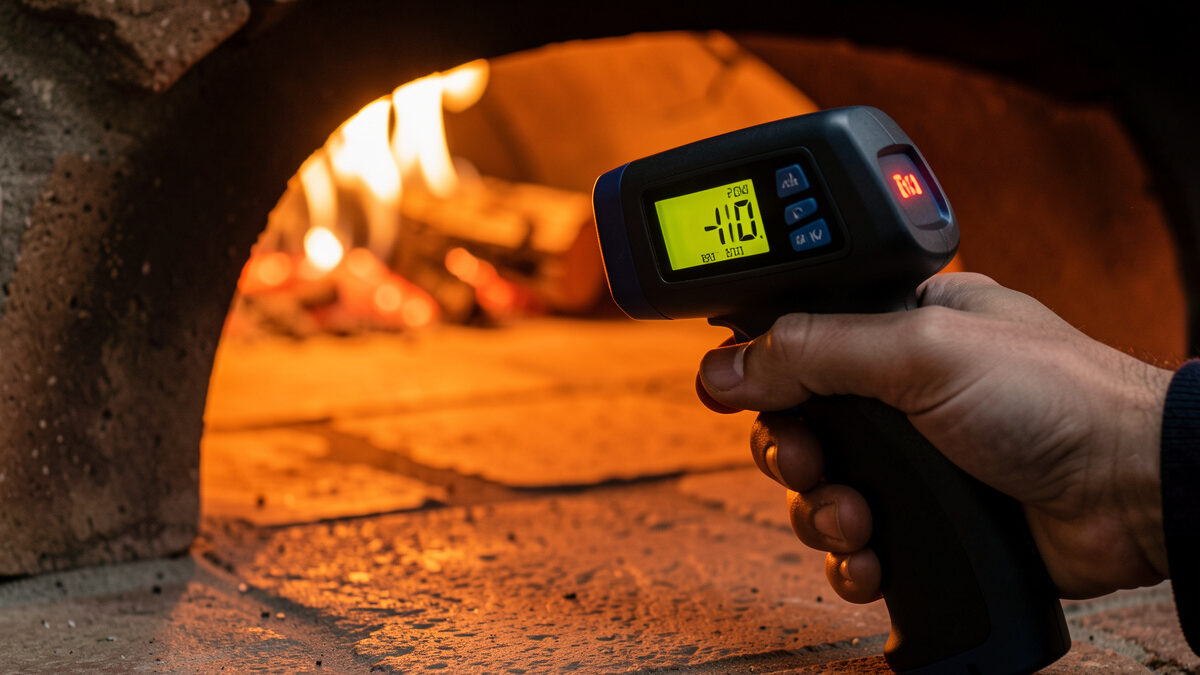
An infrared thermometer is worth it for any pizza oven, full stop — it’s the cheapest accessory that directly decides whether your pizza comes out right. For about $20 to $40 it reads the stone’s surface temperature in a second, and that number is what tells you to launch now or wait. A stone that looks ready and one that actually is ready are routinely 80 to 100°C apart, and guessing that gap by eye is the single most common cause of a pale, gummy base under a charred top.
This is the buying-decision piece: whether to spend the money, and what specs actually matter when you do. For where to aim it and how to read recovery between bakes, that’s the separate read-the-stone technique guide — here I’m answering “is it worth it” and “which one.”
Why It’s Worth It: The Launch Decision
The IR gun earns its money because it measures the one number that matters: the surface temperature of the stone, which is what actually cooks the base of your pizza. Oven-air temperature and the glow of the dome tell you the oven is hot; only the stone-surface reading tells you it’s hot in the right place at the right value for your style.
Without it, you’re guessing, and the guesses fail in both directions. Launch onto a stone that’s too cool and the base stays pale and bready while the top cooks — the classic underbaked-bottom problem. Launch onto a stone that’s overshot and the base scorches black in seconds before the top has set. The gun closes that gap to a number you can act on. I check the stone before every launch, and the reading decides everything: the full map of what value to target for each style is in stone temperature by style, and holding those numbers is the temperature discipline guide.
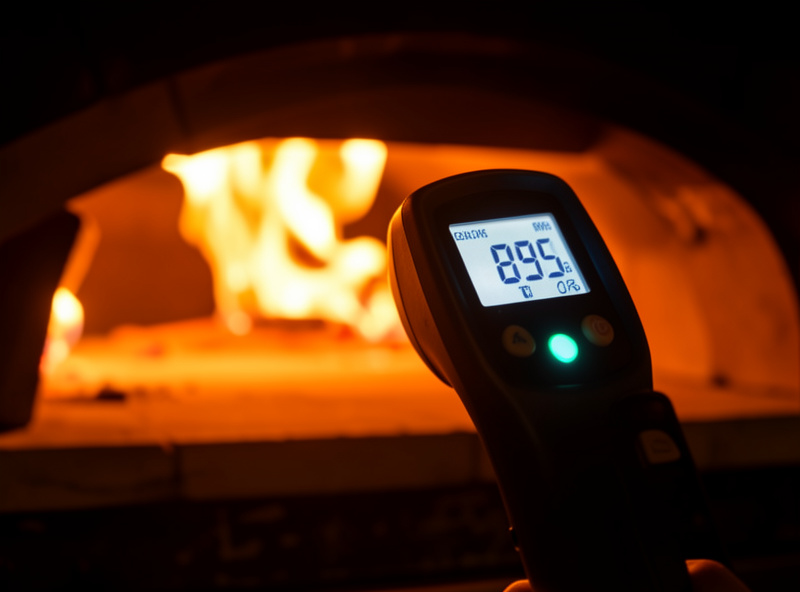
It pays for itself fastest on a fast oven. In a 90-second Neapolitan bake there’s no time to recover from a wrong launch temperature — the pizza is done before you can react. The IR gun is what makes that fast bake repeatable instead of a gamble, which is why I rate it alongside the launch peel as day-one kit in the accessories guide.
What Specs Actually Matter
Three specs decide whether an IR thermometer is right for pizza: the temperature range, the distance-to-spot ratio, and emissivity. Get those right and almost any unit works; get the range wrong and the tool is useless exactly when you need it.
Temperature range is first. A pizza stone in a hot oven runs well past 400°C, so you need a gun rated to at least 500°C, ideally higher. Plenty of cheap kitchen and HVAC IR thermometers max out around 380°C and simply read “HI” on a pizza stone — worthless for this job. Check the top of the range before anything else.
Distance-to-spot ratio (D:S) tells you how big an area the gun averages at a given distance. A 12:1 ratio means at 12 cm it reads a 1 cm spot; stand farther back and it averages a wider area. For pizza you want to read a specific patch of stone, so a tighter ratio and a sensible working distance matter — too wide and you’re averaging the cool front edge with the hot center. Emissivity is the third: stone and firebrick sit around 0.9 to 0.95, and most guns fixed at 0.95 are close enough that the error is trivial. A unit with adjustable emissivity is a nice-to-have, not a requirement. As an Amazon Associate I earn from qualifying purchases. A 500°C-plus infrared thermometer with a 12:1 ratio covers every home oven class.
What to Look For at a Glance
Here’s the short spec sheet I’d hold any pizza IR thermometer to. Spend on range and spot ratio; ignore the marketing features that don’t touch accuracy.
| Spec | What to get | Why it matters |
|---|---|---|
| Max temperature | 500°C or higher | Stones exceed 400°C; low-range guns read “HI” |
| Distance-to-spot | 12:1 or tighter | Reads a specific patch, not an average |
| Emissivity | 0.95 fixed is fine | Stone sits near 0.9–0.95; error is trivial |
| Response time | Under 1 second | Fast checks between launches |
| “Pizza-branded” premium | Skip it | Same sensor, logo markup |
That last row is the trap. “Pizza-specific” IR thermometers are usually a standard meter with a logo and a markup — the physics of reading a hot surface doesn’t care about the branding. Buy on range and spot ratio, not on whether the box has a pizza on it.
The Limits: What It Won’t Tell You
An IR thermometer reads surface temperature only — it can’t tell you the deck has heat-soaked all the way through. A stone can show the right surface number while its core is still cold, which is why the first pizza of the night sometimes disappoints even when the gun looked right. That’s a heat-soak issue, not a thermometer fault, and the fix is patience, covered in heat soak explained.
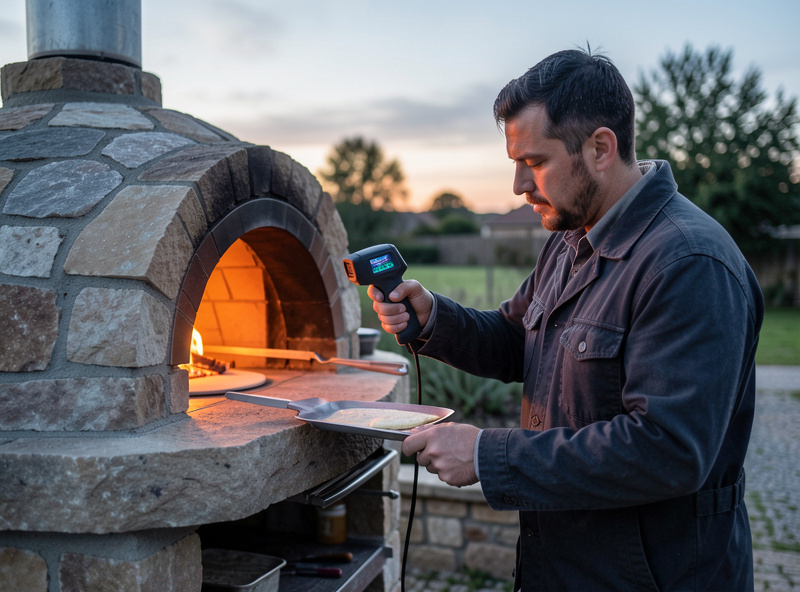
It also won’t manage recovery for you between pizzas. Each launch pulls heat out of the surface, and the gun shows that drop — but reading it well, knowing how long to wait for the stone to climb back into range, is technique. That’s where the heat recovery guide and the read-the-stone guide take over. The thermometer gives you the number; using the number across a full bake session is the skill. None of that changes the verdict, though: at $20 to $40, the IR gun is the highest-value accessory you can buy for any pizza oven, and the only instrument I genuinely won’t bake without.
IR Gun vs the Oven’s Built-In Gauge
Plenty of ovens ship with a dial thermometer or a digital readout, and people ask whether that makes the IR gun redundant. It doesn’t. Built-in gauges almost always read air or dome temperature, not the stone surface, and those two numbers diverge constantly — the dome can be roaring hot while the stone is still climbing, or the stone can be scorching while the air gauge looks moderate. The base of your pizza cooks on the stone, so the stone number is the one that counts, and only the IR gun gives it to you directly.
I treat a built-in gauge as a rough “is the oven in the ballpark” indicator and the IR gun as the actual launch decision. On my indoor electric, the panel readout tells me the elements are working and the chamber is roughly where I set it; the IR gun then confirms the biscotto stone has actually reached the surface temperature I want before the first pizza goes in. The two answer different questions, and the cheap handheld gun answers the more important one.
There’s a durability angle too. A handheld IR thermometer isn’t bolted to one oven — it reads the stone in my gas oven, the deck of the electric, and the steel under my home-oven broiler with the same single tool. That’s part of why it’s such good value: one $30 instrument covers every oven class I run, indoors and out, while each oven’s built-in gauge only ever speaks for itself. Buy the gun once and it follows you across every setup you’ll ever bake on.
Frequently Asked Questions
Is an infrared thermometer worth it for a pizza oven?
Yes. For 20 to 40 dollars it reads the stone surface temperature in a second, which is the number that decides whether you launch now or wait. A stone that looks ready and one that is ready are often 80 to 100C apart, so the gun directly prevents pale, gummy bases and scorched ones.
What temperature range do I need for a pizza IR thermometer?
At least 500C, ideally higher. A pizza stone in a hot oven runs well past 400C, and cheaper kitchen or HVAC guns that max out near 380C simply read HI and are useless. Check the top of the temperature range before any other spec.
Do I need a pizza-specific infrared thermometer?
No. Pizza-branded IR thermometers are usually a standard meter with a logo and a markup. The physics of reading a hot surface does not change with branding. Buy on temperature range and distance-to-spot ratio instead, and a general-purpose 500C-plus gun works perfectly.
What does distance-to-spot ratio mean?
It is how large an area the gun averages at a given distance. A 12:1 ratio reads a 1 cm spot at 12 cm. For pizza you want to read a specific patch of stone, so a tighter ratio at a sensible distance avoids averaging the cool front edge with the hot center.
Can an IR thermometer tell me if the stone is heat-soaked?
No, it reads surface temperature only. A stone can show the right surface number while its core is still cold, which is why the first pizza sometimes disappoints. Heat-soak is solved with patience, not the thermometer, by letting the deck warm fully before the first launch.
Where should I point the infrared thermometer?
Aim at the patch of stone where the pizza will actually land, usually the center, not the cooler front edge or the wall. Reading the spot you bake on gives the launch decision its accuracy. The full aiming and recovery technique is its own guide on reading the stone.
Related Guides
- Pizza Oven Accessories: The Complete Guide
- IR Thermometer Guide: Read the Stone
- Pizza Stone Temperature by Style
- Pizza Oven Heat Recovery
- Pizza Peel Size Guide
- Turning Peel: Is It Worth It?

About Kenny Nyhus Fadil
A home pizza maker documenting deck temps, dough logs, and the occasional wrecked launch.