Best Flour for Pizza: The Complete Guide

The best flour for pizza is the one matched to your oven’s heat and bake time: for a home Neapolitan oven running 430–480°C with a 60–90 second bake, a 00 flour around W260–300 wins; for a 250–300°C home oven on steel with a 5–7 minute bake, a strong bread flour at 12.5–13.5% protein gives better structure. Flour choice is a heat decision before it is a taste decision.
I have spent years running one dough protocol as the control and rotating ovens against it — gas, dual-fuel, indoor electric, and a 6mm steel in the kitchen oven — and the single most common mistake I see is people buying flour for the bag’s reputation instead of for the heat they actually bake in. A sack of imported 00 in a 250°C home oven will give you a pale, tough disc, because it was milled for a fire that your oven cannot make. This guide is the map: how to read a flour bag, which flour fits which oven class, and how protein, W-strength, and milling actually change the slice. The deeper articles in this cluster then take each thread further.
Flour choice starts with one number: your bake time
Before protein, before brand, before “00 versus bread flour,” there is one variable that decides everything — how long your pizza sits in the heat. A Neapolitan-style bake finishes in 60–90 seconds; a home-oven steel bake takes 5–8 minutes. That single difference reorders every flour priority you have.
At 90 seconds, the dough barely has time to set before it is out, so you want a flour that delivers fast oven spring and tolerates extreme heat without the sugars scorching to bitterness. That points to a finely milled, moderate-to-strong wheat with a controlled sugar profile — the classic Neapolitan 00. At 6 minutes in a cooler oven, the crust has to hold its shape through a long, gentle bake, which rewards more protein and a stronger gluten network so the rim does not collapse into a cracker. When I check the stone with the IR gun and it reads 430°C, I reach for a different bag than when my steel tops out at 285°C — same dough log, different flour. Everything below is downstream of this one fact. If you only remember one thing from this hub, remember that the oven picks the flour.
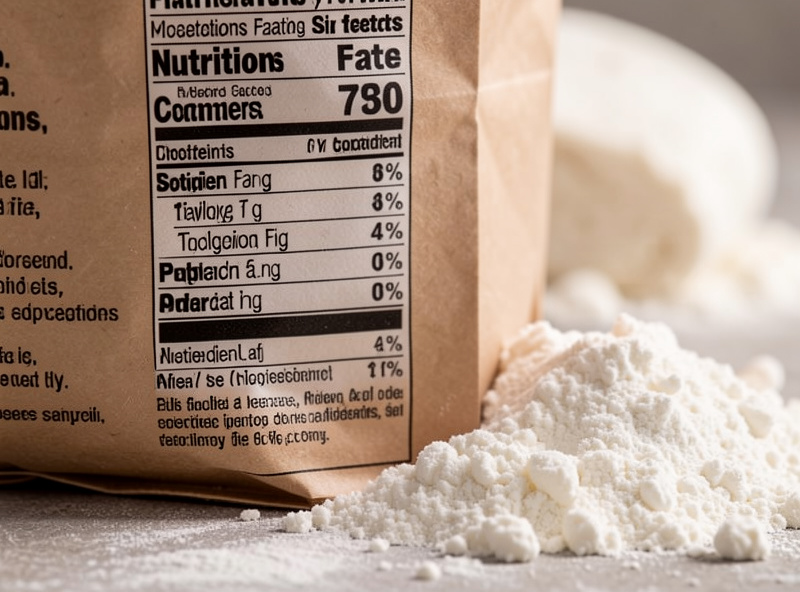
How to read a flour bag (protein, W-strength, ash, falling number)
Most flour decisions are won or lost reading the side panel. Four numbers matter, and only one of them is printed on every bag sold in a supermarket. Learn these and you stop buying by brand mythology.
Protein percentage is the one number you always get. It is a rough proxy for how much gluten the flour can form. Pizza flours run from about 9% (soft, low-protein) to 14.5% (very strong). For a home oven, aim 12.5–13.5%; for a hot Neapolitan oven, 11.5–13% is plenty because the short bake does not stress the rim. W-strength is the number Italian millers actually care about — it measures the flour’s resistance and extensibility together on an instrument called an alveograph. A W of 220–260 is medium; 260–320 is strong; above 350 is “manitoba” territory built for very long ferments. W is rarely printed on consumer bags, which is why I default to protein percentage and the manufacturer’s stated recommended leavening time as a stand-in.
Ash content tells you how much of the bran and germ survived milling — it is the technical line between a refined white flour (low ash, “00” or “0”) and a wholemeal or stone-ground flour (high ash). Falling number measures enzyme activity and matters mostly for very long ferments, where too much amylase turns dough slack and sticky. You will almost never see falling number on a home bag, but it is the hidden reason a cheap flour goes to soup at 72 hours while a good one holds. I cover the protein-to-gluten chain in detail in the gluten development guide, and the W-strength angle for long ferments in the high-protein flour guide.
The flour classes, side by side
There are really only a handful of flour classes you need to know for pizza. The names get confusing because Italian and American milling systems label the same idea differently — “00” describes how finely a flour is ground, not how strong it is, which trips up nearly every beginner. Here is how the classes compare on the things that change your slice.
| Flour class | Typical protein | Best oven / bake | What it gives | Watch out for |
|---|---|---|---|---|
| 00 pizza flour (Neapolitan) | 11.5–13% | 430–480°C, 60–90s | Soft, extensible, fast spring, tender leoparded rim | Goes pale and tough in a cool home oven |
| Strong bread flour | 12.5–14% | 250–300°C, 5–8 min | Structure, chew, holds shape over a long bake | Can be tight; needs more rest to relax |
| All-purpose / plain | 9–11.5% | Pan and thin home styles | Tender, easy to roll, forgiving | Weak rim, poor spring at high heat |
| Semolina (rimacinata) | 12–13% | Blends, Sicilian, peel dusting | Color, nutty flavor, structure, crisp bite | Tightens dough; rarely used at 100% |
| Whole wheat | 13–14% | Blends up to ~30% | Flavor depth, fiber, color | Sharp bran cuts gluten; absorbs more water |
| Stone-ground | Varies | Flavor-forward blends | Aroma, character, more of the grain | Coarser, thirstier, less consistent |
Read that table as a starting grid, not a verdict. The two classes most home bakers wrestle with are 00 and bread flour, and the honest answer to “which is better” is “for which oven” — I unpack that exact decision in the 00 flour vs bread flour comparison. Semolina, whole wheat, and stone-ground are mostly blend ingredients rather than 100% bases, and each gets its own deep dive in this cluster.
Matching flour to your oven class
This is where my test lab earns its keep. I bake the same dough across four oven classes, and the flour that wins changes with the machine every time. Here is the practical mapping, oven by oven.
Portable gas (Ooni Koda 16 class): these run hot and fast — stone temps of 400–450°C, bakes under 90 seconds. A Neapolitan 00 at 11.5–13% protein is the natural fit; the short bake means you do not need a huge W-strength unless you are pushing a 72-hour ferment. The one quirk I have logged over hundreds of bakes is uneven left-wall heat, which rewards a flour that takes a fast turn without tearing — extensible 00 again. The gas vs wood comparison covers the heat behavior in full.
Dual-fuel dome (Gozney class): same Neapolitan window, but the larger thermal mass holds heat through more bakes, so a slightly stronger flour (W up to 300) survives a long evening of back-to-back launches without the rim going gummy. Indoor electric (Effeuno class, 450°C with a biscotto stone): my Swedish-winter weapon and the all-year consistency reference. Because the heat is steady and the bake is short, this is the most flour-forgiving oven I own — a good 00 sings here. I cover why in the indoor electric verdict.
Home oven on steel or stone (the baseline): this is where flour choice matters most, because the oven is working against you. A 6mm steel beats a stone for transfer, but even maxed out you are baking 5–8 minutes at 250–290°C. Reach for strong bread flour at 12.5–13.5%; the longer bake needs the extra protein to hold a real rim instead of a crisp wafer. If you only own a home oven, do not buy imported 00 first — buy a good bread flour and learn the broiler method. The cheapest upgrade to your pizza is almost never the flour brand; it is a colder, longer ferment, which I cover in the 48-hour cold ferment guide.
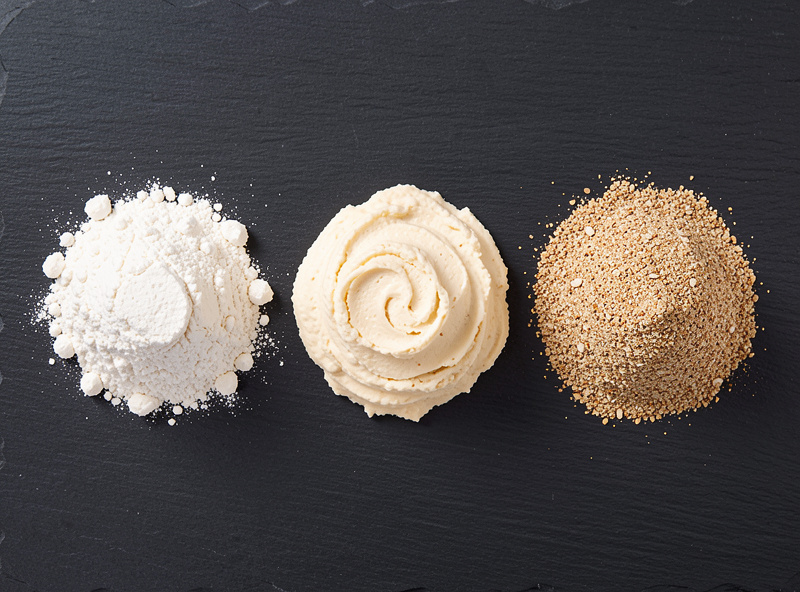
What protein actually does in the dough
Protein gets treated like a quality score — “higher is better” — and that is wrong. Protein is the raw material for gluten, the elastic network that traps gas and gives the rim its spring and chew. More protein means a stronger, tighter network; less means a softer, more tender one. Neither is universally better; they suit different ovens.
When flour meets water and you mix, two proteins — glutenin and gliadin — link into gluten. Glutenin gives strength and elasticity (the dough snaps back); gliadin gives extensibility (the dough stretches without tearing). A good pizza flour balances both. A high-protein flour at 14% can form so much gluten that the dough fights you on the launch peel — it shrinks back as you stretch. A soft 9% flour stretches like a dream but cannot hold a tall rim through a long bake. The art is matching the protein to the bake: short and hot forgives lower protein; long and cool demands more. This is why “what flour for Neapolitan” and “what flour for home-oven pizza” have different answers even though both are pizza. The full mechanism — hydration, mixing, rest, and how the network builds — lives in the gluten development guide, and the practical hydration pairing is in the hydration guide.
W-strength, ferment time, and why strong flour resists collapse
Here is the link most flour guides skip: W-strength and ferment time are a matched pair. A long ferment is a slow demolition — enzymes and acids gradually weaken the gluten network over hours. A weak flour starts that demolition already fragile, so by 48 or 72 hours it has gone slack and sticky and will not hold a ball. A strong flour (higher W, higher protein) has structure to spare, so it survives the long ferment and arrives at the launch still springy.
In my dough log, the pattern is consistent: a same-day dough is happy on a medium flour around W240; my standing 48-hour cold ferment wants W260–300; and on the rare 72-hour push I want W300+ or the dough turns to batter in the tray. This is the real reason imported “strong” 00 exists — not because Neapolitan pizza needs raw power, but because the long cold ferment that gives the flavor needs a flour that can survive it. If you ferment short, you do not need a strong flour; if you ferment long, you must have one. Match the bag to your schedule, not to a forum’s favorite brand. The same-day vs overnight guide shows how the schedule shifts the flour requirement, and the poolish method adds another wrinkle for preferments.
Blending flours: semolina, whole wheat, and stone-ground
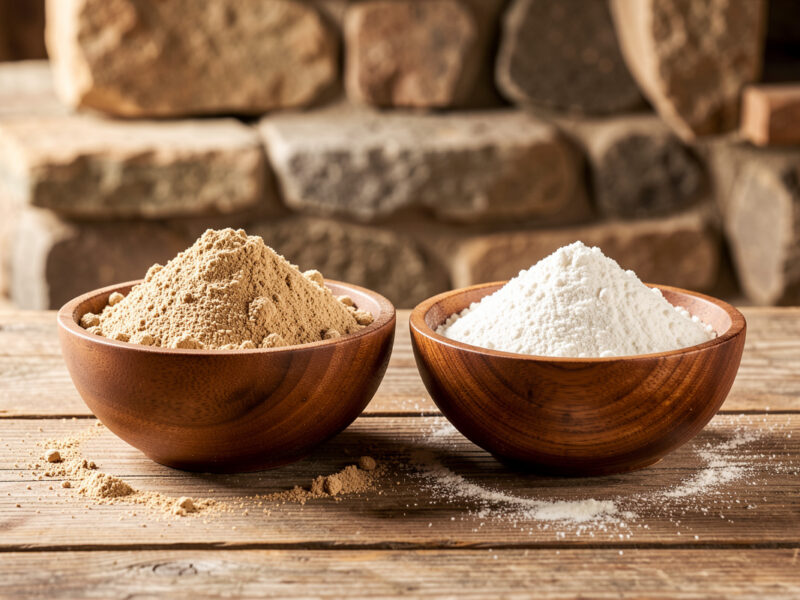
Once you are comfortable with a base flour, blending is where the slice gets personal. You rarely bake pizza on 100% semolina or 100% whole wheat — both work best as a percentage of a stronger white base. A 10–20% semolina addition adds a faint nutty sweetness, a touch more color, and a satisfying crisp snap to the bite; it also tightens the dough, so I add a point or two of water to compensate. The full method is in the semolina guide.
Whole wheat brings flavor and color but its sharp bran particles physically cut the gluten strands as they form, weakening structure — which is why a 100% whole wheat pizza bakes dense and tears easily. I keep it to 20–30% of the flour and lean on a strong white base to carry the rim, plus extra hydration and a longer rest so the bran softens. The whole wheat guide walks through the ratios. Stone-ground flours sit in their own category: ground between stones rather than steel rollers, they keep more of the germ and bran and carry more aroma, but they are coarser and thirstier and less consistent batch to batch. Whether that trade is worth it is the subject of the stone-ground vs refined comparison.
Caputo and the imported-00 question
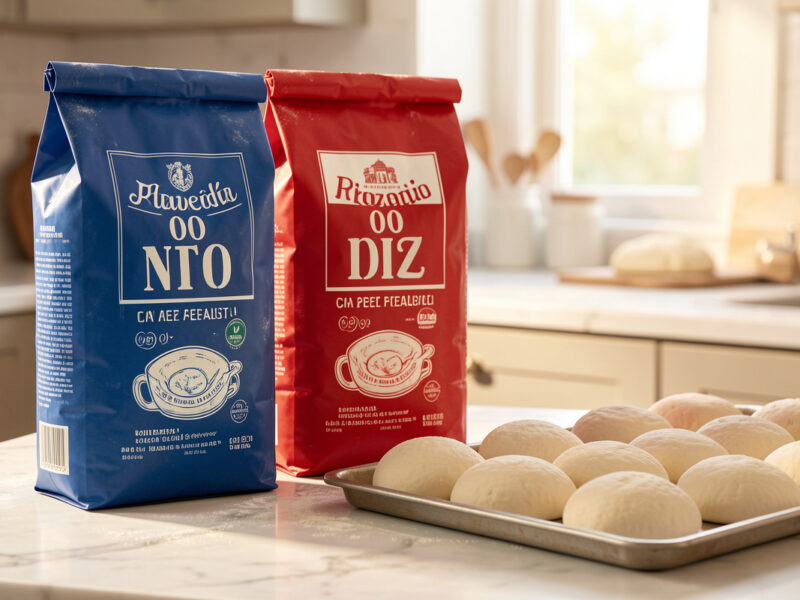
If you have read anything about pizza flour, you have read about Caputo. It is the default Neapolitan reference for a reason — consistent milling, a range built specifically for different bake styles, and availability worldwide. But “buy Caputo” is not a complete answer, because the brand sells several flours with very different strengths, and the wrong one in the wrong oven still disappoints. The blue-bag Pizzeria line is the everyday Neapolitan workhorse; the red Cuoco/Chef line is stronger for longer ferments and hotter, longer professional bakes. Picking between them is again a question of your oven and your ferment, not prestige. I lay out which Caputo flour fits which setup, and when a good local bread flour does the same job for less, in the Caputo flour guide. The short version: a hot oven plus a long ferment justifies imported 00; a home oven on steel often does not.
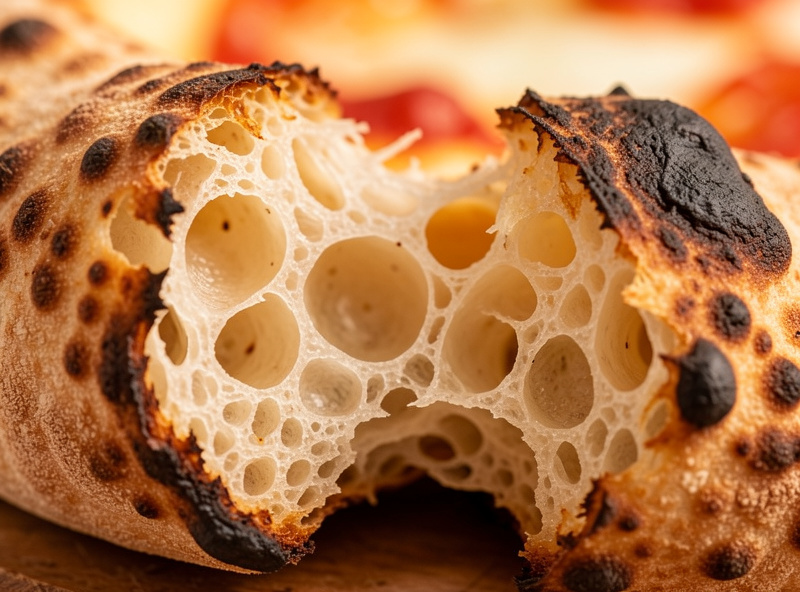
Flour freshness, storage, and why it changes the dough
Flour is not inert, and a bag that has sat open in a warm cupboard for six months does not behave like the same flour fresh. White refined flours are the most stable — sealed and cool, a 00 or strong bread flour holds its baking quality for a year or more because the oily germ has been milled out. Whole wheat and stone-ground flours are the opposite: they still contain the germ, and that germ oil goes rancid, turning the flour bitter and slack within a couple of months at room temperature. This is the single biggest reason a whole-grain pizza tastes “off” when the flour itself was the problem, not the recipe.
My practice is simple and worth copying. Refined white flours live in a sealed airtight container in a cool, dark cupboard, bought in quantities I will use within a few months. Whole wheat and stone-ground flours go in the freezer in zip bags, brought to room temperature before mixing — cold flour drags down dough temperature and slows the ferment, which throws off the schedule in my dough log. I date every bag with a marker the day it is opened. Freshly milled and recently opened flour also absorbs water slightly differently than old stock, so when I switch to a new bag I expect to nudge hydration by a percent or two until the dough feels right under the hands. None of this is fussy for its own sake; stale or rancid flour quietly undoes everything you do right afterward, and it is the cheapest variable to control.
The flour mistakes I see most often
After enough bakes you start to recognize flour problems by the finished crust. A pale, tough, blistered-but-not-leoparded rim usually means a high-heat 00 baked too cool — wrong flour for the oven. A rim that crisps into a cracker with no chew is often too little protein for a long home-oven bake. Dough that fights you on the stretch and snaps back is too much protein or not enough rest, not a bad flour. And a ball that sags into a puddle by day two is a weak flour pushed past its ferment limit.
The biggest mistake, though, is buying the flour first and the technique never. A perfect bag of 00 will still make a bad pizza if the stone is cold, the ferment was rushed, or the launch tore the base. Flour is one input among several, and it is rarely the cheapest fix. Before you spend on a premium import, get your stone temperature right, dial your hydration, and give the dough time. If the dough is sticky and unworkable, that is usually hydration and handling, not flour — the sticky dough fix covers it. Get those right on an ordinary flour and you will out-bake someone using imported 00 with a cold stone every time.
How to choose your flour in three questions
Strip away the brand noise and the decision comes down to three questions. One: how hot does my oven actually get? Check it with an IR gun, not the dial. If the stone reads 400°C+, you are in Neapolitan territory and a 00 fits; if it tops out around 280°C, buy strong bread flour. Two: how long do I ferment? Same-day means a medium flour is fine; a 48–72 hour cold ferment demands a strong, high-W flour that survives the wait. Three: what do I want the slice to taste like? Clean and classic stays refined white; deeper and nuttier brings in semolina, whole wheat, or stone-ground as a percentage.
Answer those three honestly and the bag almost picks itself. A hot oven, a long ferment, and a classic taste means imported 00 or a strong local equivalent. A home oven, a same-day dough, and a hearty slice means strong bread flour with a little semolina. There is no single best flour — only the best flour for your heat, your schedule, and your palate. Build from your oven outward, log what works, and let the dough book tell you the truth over time. The same sourdough culture that runs my fermentation bench raises every pizza on this site, and even that starts with the right flour in the bag — explore the complete dough guide and the sourdough pizza guide to take the next step.
Frequently Asked Questions
What is the best flour for pizza overall?
There is no single best flour. For a hot Neapolitan oven baking in 60-90 seconds, a 00 flour at 11.5-13% protein wins. For a home oven on steel baking 5-8 minutes, a strong bread flour at 12.5-13.5% protein gives a better rim. The oven and bake time decide.
Is 00 flour better than bread flour for pizza?
Only in a hot oven. 00 describes how finely the flour is milled, not its strength. In a 430C+ oven it gives a tender, fast-rising Neapolitan crust. In a cooler 280C home oven, 00 often bakes pale and tough, and a strong bread flour performs better over the longer bake.
What protein percentage should pizza flour have?
Aim for 11.5-13% protein for a hot Neapolitan oven and 12.5-13.5% for a home oven on steel. Long cold ferments of 48-72 hours need the higher end so the gluten survives the wait. All-purpose flour at 9-11% is too weak for a strong rim at high heat.
Can I use all-purpose flour for pizza?
Yes, for pan styles and tender thin-crust in a home oven. All-purpose at 9-11.5% protein is forgiving and easy to stretch, but it makes a weak rim and poor oven spring at high heat. For a real leoparded Neapolitan rim, step up to a 00 or strong bread flour.
Why does my imported 00 flour make bad pizza in my home oven?
Because 00 is milled for a 430-480C fire, not a 250-290C home oven. At low heat over a long bake it does not develop color or spring and turns pale and tough. In a standard home oven, a strong bread flour at 12.5-13.5% protein usually beats imported 00.
Does flour choice matter more than fermentation?
Usually no. A long, cold ferment and correct stone temperature improve a pizza more than upgrading flour brand. Flour is one input among several. Match a sensible flour to your oven, then invest your effort in fermentation time and launch technique before paying for premium imports.
Related Guides in This Cluster
- 00 Flour vs Bread Flour for Pizza: What Actually Matters
- High-Protein Flour for Neapolitan Pizza
- Semolina in Pizza Dough: How and Why to Use It
- Whole Wheat Pizza Dough Tips
- Understanding Gluten Development in Pizza Flour
- Caputo Flour Guide for Home Bakers
- Stone-Ground vs Refined Flour for Pizza

About Kenny Nyhus Fadil
A home pizza maker documenting deck temps, dough logs, and the occasional wrecked launch.